



A capstone practical project where students apply the knowledge gained throughout the MBA
During the 3rd residential week, some of the Monaco MBA students worked on their entrepreneurial business plans alongside Prof. Castello and entrepreneur Frederic Bouvard.
The goal of this session is to translate MBA learning into a concrete entrepreneurial project, guiding students from an initial idea to a validated, structured, and investor-ready business plan.
The Entrepreneurial Business Plan session reinforces the MBA’s experiential learning philosophy by moving students from theoretical frameworks to hands-on venture creation. Instead of studying strategy, finance, marketing, and operations in isolation, students apply these disciplines within an integrated project.
By developing a real business plan, participants apply classroom concepts to a practical venture, strengthening their understanding through action. They engage in iterative problem-solving and decision-making, much like startups do in real entrepreneurial environments. At the same time, they develop presentation and investor-pitch skills, effectively bridging academic learning with professional practice.

Dr. Alessio Castello
Professor of Management and Strategy
Students benefit from a working session with Mr. Frederic Bouvard, a serial entrepreneur, founder, and CEO of several companies. Leveraging his extensive experience, Mr. Bouvard helps participants understand the practical application of financial fundamentals and the financing process of new ventures.
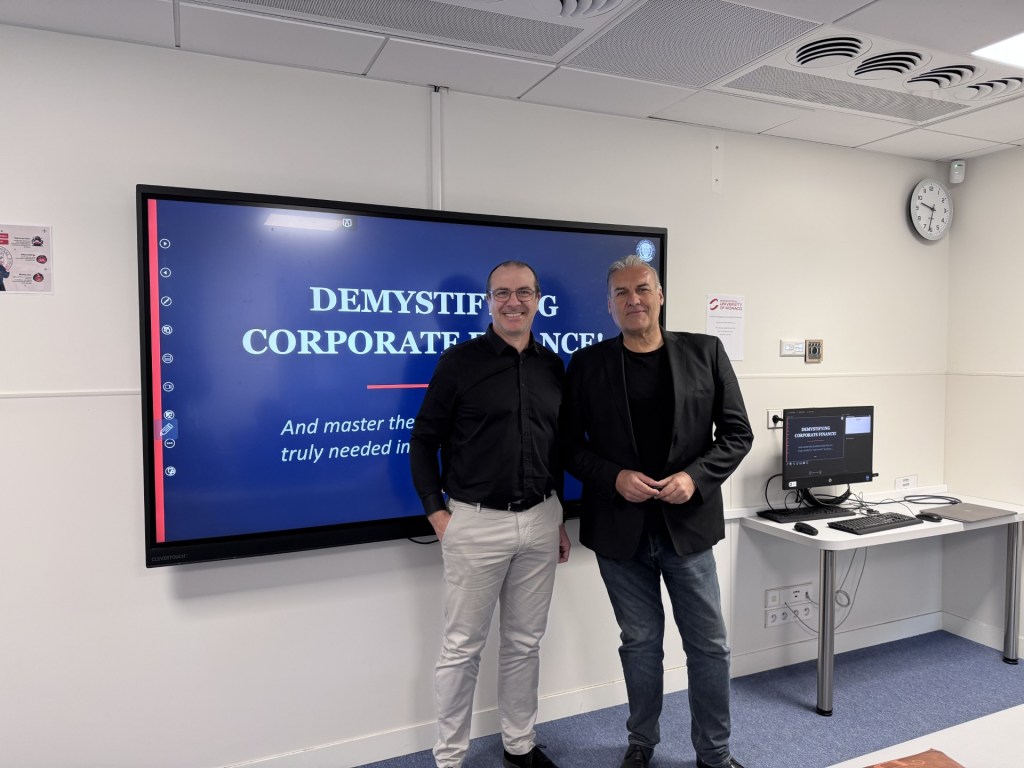
What are some common mistakes entrepreneurs make when preparing their business plans, particularly from a financial perspective?
Frederic Bouvard (FB): The main challenge is that many entrepreneurs do not have a clear understanding of how a project is structured and financed in a practical, real-world context.
They often rely on theoretical frameworks that are not fully aligned with the realities of venture creation and execution.
This leads to several recurring issues:
- Misapplication of academic models: tools such as the three-statement model are frequently used in a forecasting context where they are not appropriate. These frameworks are valuable for analyzing existing companies, but not for building a project from the ground up.
- Limited understanding of project mapping and forecasting: many students struggle to translate an idea into a structured roadmap that links operational steps, timelines, and financial implications in a coherent, actionable way. They often do not know how to build a financial model that is both convincing and sufficiently conservative.
- Overly optimistic assumptions: projections are often driven by ambition rather than by a clear assessment of execution capacity and market constraints. They do not always realize that these projections can later be used by investors as leverage to renegotiate terms or justify taking control if forecasts are not met.
- Confusion between profitability and cash generation: key drivers such as working capital variations, operating cash flow, and cash burn are often simply overlooked, despite being fundamental to a venture’s survival.
- Lack of a financing strategy: students are not always familiar with structuring financing, from defining exact funding requirements to selecting appropriate instruments, including more sophisticated or hybrid solutions.
- Insufficient preparation of the investor proposal: many underestimate the importance of structuring a clear, compelling offer that will effectively “sell” to investors, and of understanding the levers available to manage dilution, retain control, and protect their position through appropriate governance and contractual mechanisms.
Overall, business plans are often built using academic logic, rather than reflecting how ventures are actually structured, financed, and operated in practice.
As an MBA mentor, what practical advice or tools do you share with mentees to help them turn their ideas into viable ventures?
FB: The first thing I do is ensure that students truly understand the financial fundamentals they have already been exposed to.
In my experience, they often know the academic definitions but do not fully understand how these concepts work or how to use them in real-world contexts.
For example, many students know that a balance sheet must “balance”, but are unable to explain why or how the mechanism works. Similarly, they may know the academic definition of IRR but struggle to explain, in simple terms, what it really represents or why it is one of the most, if not the most, important KPIs for investors.
So my approach is to reconnect these concepts with reality.
I explain them in very simple, intuitive terms, sometimes using visual tools such as diagrams or animations, so that they can grasp not just the definition, but the underlying logic.
I also teach them how to read financial statements properly, not just to look at numbers, but to understand the story they are telling about a business, its strengths, its weaknesses, and its trajectory.
What I consistently observe is that once students truly understand the fundamentals, everything else becomes much more intuitive and actionable.
In your opinion, what makes this type of session particularly valuable for MBA students who aspire to launch their own ventures?
Alessio Castelo (AC): What makes this type of session particularly valuable is that it bridges a gap that most academic programs do not fully address: the transition from understanding concepts to actually building and financing a real project.
Another key aspect is that it changes students’ perspectives on finance.
Instead of seeing finance as a technical or abstract discipline, they begin to understand it as a tool for decision-making, structuring, and negotiation, which is critical when raising capital and operating a company.
Ultimately, the value of this session lies in a mindset shift: students move from an academic understanding of entrepreneurship to a practical, execution-driven approach.
And that shift is essential for anyone who genuinely intends to launch and sustain a venture after graduation.
In your experience, what differentiates a good business idea from one that can truly become a scalable and sustainable venture?
FB: In my opinion, the first differentiating factor is the industry itself and the broader economic environment.
Some sectors naturally lend themselves to scalability; others simply do not. No matter how strong the idea or the team, if the underlying market does not allow for repeatability, margin expansion, or volume growth, scalability will remain limited.
The second factor can be summarized in one word: execution.
Assuming the business idea has been properly mapped, structured, forecasted, and financed, what ultimately determines whether it becomes scalable and sustainable is the ability to execute.
That is what transforms a good idea into a scalable and sustainable venture.
If you are interested in our MBA program, check our website
If you have any questions, contact the Admissions Team at admissions@monaco.edu
Last update on