



We are delighted to announce the publication of his article “Pricing the Gap: Big 4 Audit Offices and Distant Private Clients” in the prestigious 4* journal Auditing: A Journal of Practice and Theory.
Domenico Campa,
is a Full Professor of Accounting and Finance at the International University of Monaco (IUM) and a member of the OMNES Education research group. He is widely recognized for the breadth and depth of his academic interests, which span several complementary domains at the intersection of accounting, auditing, and corporate governance.

- Auditing: his work examines the drivers of audit quality and auditor independence, while also addressing the evolution of the audit profession and the challenges of equality and diversity within it.
- Financial reporting quality: he investigates the determinants and constraints that shape firms’ earnings quality, analyzing how accounting standards, corporate governance mechanisms, and market pressures influence transparency and reliability.
- Corporate governance: he explores how governance structures and features affect company dynamics, offering insights into the balance between oversight, accountability, and strategic performance.
- Sports industry: he extends his expertise to the world of sports, analyzing strategic, managerial, and accounting issues in a sector where financial management and organizational strategy are increasingly critical.
Through this diverse portfolio, Dr. Campa’s research provides valuable guidance for regulators, practitioners, and academics, highlighting the complex interplay between standards, governance, market incentives, and audit practices. His work not only advances academic knowledge but also offers practical insights into how organizations can strengthen transparency, accountability, and strategic decision‑making.
A major academic milestone
This publication, co‑authored with Drs. Mara Cameran and Mario Daniele, represents a significant milestone and international recognition of the quality of research conducted at the International University of Monaco (IUM). Being published in such a leading journal is not only a mark of academic excellence but also a testament to the relevance and impact of the work on professional audit practices.
It highlights the ability of IUM’s faculty to contribute meaningfully to global debates on auditing and financial reporting, reinforcing the institution’s reputation as a center of rigorous and innovative scholarship. The achievement demonstrates how research carried out at IUM resonates beyond academia, offering insights that are valuable to regulators, practitioners, and decision‑makers navigating the complexities of today’s audit environment.
A timely and relevant topic
The article explores how the Big 4 audit firms approach pricing decisions in specific contexts, particularly when working with distant private clients. This line of inquiry is especially important because it addresses a segment of the audit market that has traditionally received little scholarly attention. By focusing on unlisted companies located far from the offices that serve them, the research highlights how geographic distance and office capacity constraints can shape pricing strategies.
This underexplored area is crucial for understanding the real dynamics of the audit market, as it reveals that pricing is not uniform but influenced by contextual factors such as client location, office performance, and resource allocation. In doing so, the study sheds light on the strategic behavior of audit firms, showing how they balance resource efficiency, competitiveness, and client acquisition.
Ultimately, the findings contribute to a broader understanding of how the audit profession adapts to structural and organizational challenges, offering insights that are valuable not only to academics but also to regulators and practitioners seeking to grasp the complexities of audit pricing in the private client segment.
An original contribution
This study makes a distinctive contribution by examining how Big 4 audit offices in the UK set their fees when serving private clients located more than 100 kilometers away, even when a closer office of the same firm is available. By focusing on this underexplored segment of unlisted companies, the research highlights that audit pricing is not uniform but shaped by contextual and organizational factors.
The findings shed light on:
- Pricing strategies adopted by audit offices, showing that distance can lead to fee reductions.
- Organizational determinants such as office size, location in different UK nations, and performance levels, which influence how discounts are applied.
- The importance of capacity utilization and fixed‑cost management in shaping competitive pricing decisions.
Methodology
The study is based on a robust dataset drawn from several hundred audit engagements in the United Kingdom. The authors compare the fees charged to nearby clients with those paid by distant clients, defined as those located more than 100 kilometers away from the audit office, even when a closer office of the same firm is available. To ensure the reliability of the results, the advanced econometric models that isolate the specific effect of distance on audit fees, allowing the researchers to capture genuine pricing dynamics rather than external distortions. The study also uses interviews with two Big 4 audit partners.
Key Findings
The results reveal that distant clients tend to benefit from fee reductions, particularly when the offices serving them have fewer clients or are seeking to optimize their capacity. Higher‑performing offices are also more likely to grant larger discounts, reflecting strategies aimed at expanding their client base. These reductions are concentrated among mid‑sized companies, which appear more sensitive to pricing adjustments, while larger firms involve greater complexity, higher audit risk, and more intensive partner and specialist involvement and smaller firms leave limited room for fee discounts because they already pay relatively low fees. In terms of audit quality, the study shows that distant clients display greater discretion in accounting accruals, though this does not translate into audit failures.
Broader impact
Beyond its academic contribution, the study opens new perspectives for practitioners and decision‑makers:
- The study highlights how audit offices balance their resources and client portfolios to remain competitive. By examining the allocation of engagements between nearby and distant clients, it shows that offices must carefully manage their capacity and fixed costs while seeking to expand their reach. This balancing act is essential to maintain efficiency and ensure sustainable growth in a highly competitive environment.
- It also demonstrates how market dynamics influence pricing in a sector often perceived as standardized. Contrary to the assumption of uniformity, the findings reveal that geography, office performance, and client characteristics all play a role in shaping pricing decisions. This perspective underscores the complexity of the audit market, showing that fees are not fixed but respond to nuanced strategic pressures and local conditions.
- Finally, the research sheds light on how local office strategies contribute to the overall competitiveness of the Big 4. By adapting their pricing policies to specific contexts, such as serving distant clients or targeting mid‑sized companies, individual offices strengthen the broader network’s ability to attract and retain clients. These localized strategies, though subtle, are critical in reinforcing the global dominance of the Big 4 and demonstrate how micro‑level decisions feed into macro‑level competitiveness.
By revealing the interplay between geography, organizational capacity, and pricing, this research enriches our understanding of audit market dynamics and provides actionable insights for regulators and professionals alike.
▶ Read the full article: Link to publication
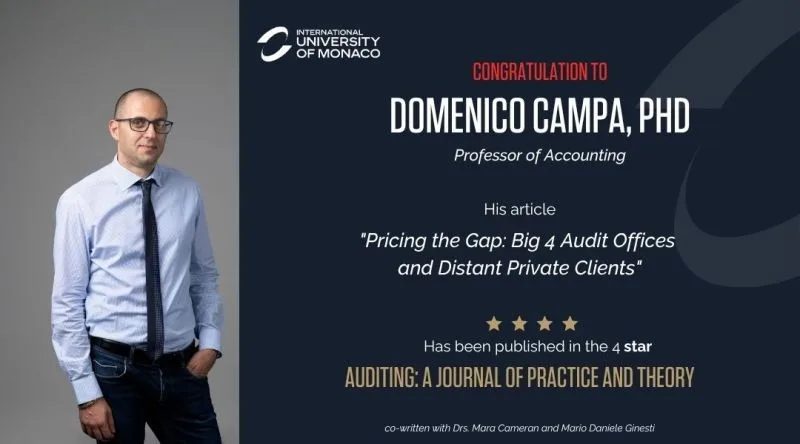
✨ This success illustrates the excellence of research at IUM and its international reach, reinforcing the connection between academic research and professional practice. ✨
For more information about our Master in Finance, check our website
If you have any questions, contact the admissions team at admissions@monaco.edu
Last update on