


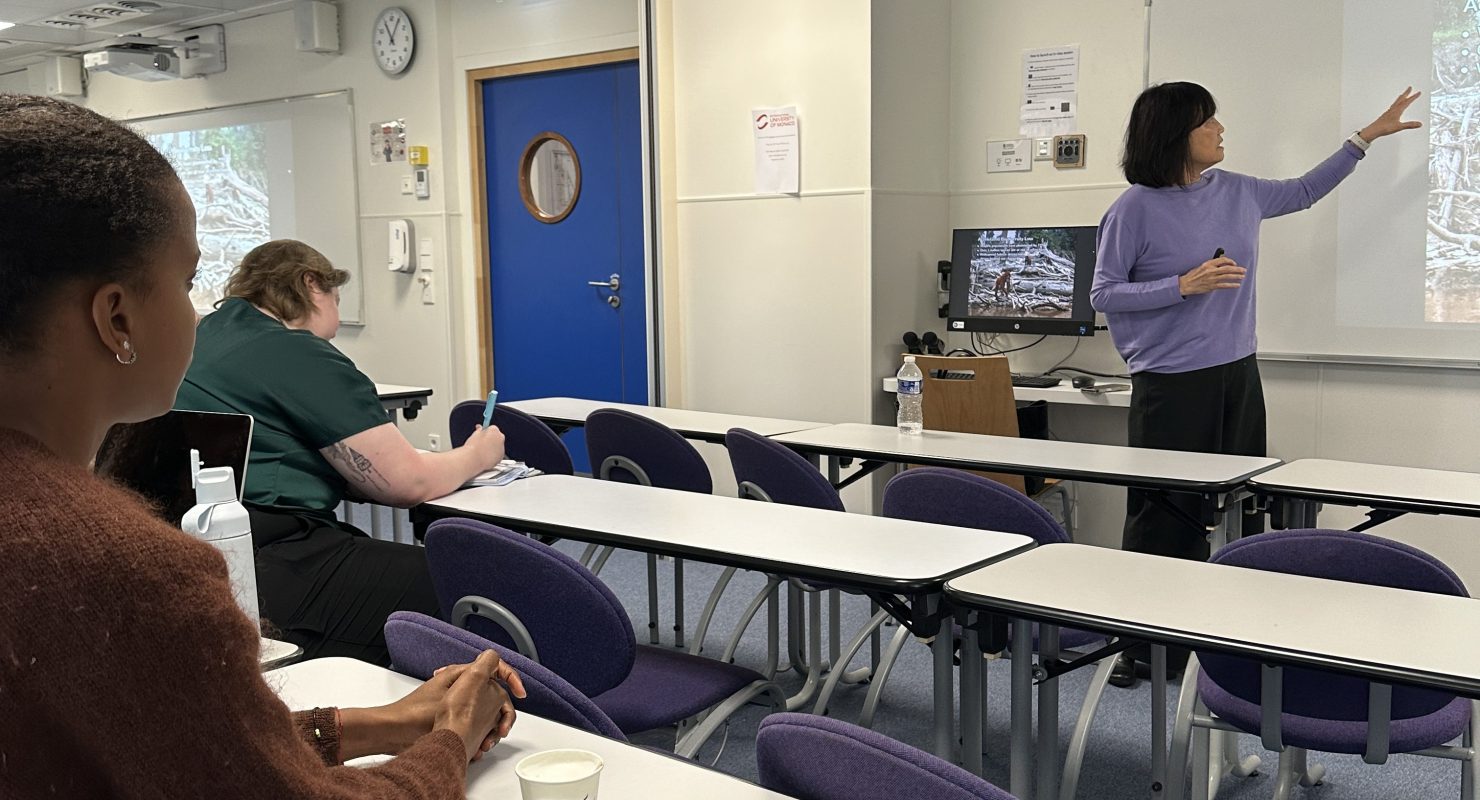
“Rethinking Value in a Nature-Dependent Economy”- An Interview with Prof. Lilian Ng
1. What inspired you to focus your research on the intersection between finance and biodiversity?
My research shows that financial markets are powerful drivers of corporate behavior — they shape how firms allocate capital, manage risks, and respond to environmental challenges. Over the past decade, we’ve seen how climate finance has reshaped corporate incentives, yet biodiversity, the other half of our planet’s sustainability challenge, hasn’t received the same attention. Through my earlier work in climate finance and the global momentum around the 2022 Kunming–Montreal Biodiversity Agreement, I started to wonder: Do biodiversity risks influence corporate policies and valuation? That question set me on a new path to study how investors and firms respond to biodiversity exposure and nature-related financial risks.
2. Why should business schools and finance students pay close attention to biodiversity-related risks and opportunities?
The loss of biodiversity isn’t just an environmental issue; it’s also an economic one. It affects how firms are valued, their regulatory exposure, investor pressure, and even their reputation.
And as new frameworks like the TNFD (the Taskforce on Nature-related Financial Disclosures) gain traction, understanding these risks is quickly becoming part of mainstream finance.
For business schools and finance students, this means something very practical: learning how to price nature-related risks, assess biodiversity impacts, and identify investment opportunities that deliver both financial returns and ecological resilience.
Put simply, knowing how financial decisions affect and depend on nature will be an essential skill for future finance leaders.
3. What kind of skills or knowledge should future finance professionals acquire to navigate sustainability-driven changes in the industry?
I think future finance professionals will need a blend of traditional financial expertise and a strong understanding of sustainability frameworks. It starts with being familiar with ESG reporting standards, sustainability accounting, and the new regulatory frameworks that are emerging.
But there’s another layer to it — biodiversity. Unlike climate finance, the tools to measure and value biodiversity risks are still developing and not widely understood.
That’s where the next generation can make a big impact. Finance professionals will increasingly need to work with non-financial data, such as environmental metrics and even geospatial information. In my own research, for example, I look at firms’ proximity to protected areas as a measure of biodiversity exposure. Integrating that kind of information into investment analysis and corporate strategy will become essential as sustainability becomes part of mainstream finance.
4. How can students, regardless of their field of study, contribute to biodiversity protection in meaningful ways?
I firmly believe that every student, regardless of their field, can contribute to protecting biodiversity. You don’t have to be an environmental or nature scientist to make a difference. It starts with small, everyday choices -supporting sustainable products, reducing waste, and being mindful of consumption. However, it also means utilizing your skills, whatever they may be, to make a positive impact.
If you’re in business or engineering, you can design nature-positive technologies or push companies to adopt greener practices. If you’re in communications or law, you can raise awareness or shape better policies. Even holding corporations accountable and advocating for transparency makes a difference.
In short, protecting biodiversity isn’t someone else’s responsibility, but it’s something we all share as responsible
citizens.
5. Do you believe that protecting biodiversity and achieving economic growth can go hand in hand? If so, how?
Absolutely. I truly believe the two can go hand in hand. Economic growth that ignores nature’s limits is not sustainable in the long run. However, if we direct our investments toward biodiversity-friendly innovation, such as nature-based solutions, green infrastructure, or circular business models, then economic growth can actually support conservation instead of harming it.
The key is to create incentives. When protecting nature also makes good business sense, that is when we start seeing real and lasting change. Ultimately, it’s not about choosing between the economy and the environment; it’s about making sure they thrive together. After all, there’s no Planet B to fall back on.
6. What do you find most rewarding about researching and teaching on such a complex, interdisciplinary topic?
Honestly, what I find most rewarding is the sense that I can truly make a difference- as both a researcher and an educator. I care deeply about the environment, and for the first time, I feel that my work connects finance with issues that matter for our planet.
In the classroom, I always bring current issues like climate change and biodiversity loss to life. I want to help my students understand that finance isn’t just about numbers; it is also about shaping decisions that impact ecosystems, communities, and the future economy. If I can inspire even a few students to realize that finance can be a force for good, that is incredibly meaningful to me.
On the research side, I hope my findings can help inform policymakers and guide firms and investors to make decisions that better account for nature-related risks and opportunities. For example, one of my former MBA students (a First Nations person) recently shared how what he learned in class helped him advise Indigenous communities on impact investments. Stories like that really remind me why this work matters, as they show that knowledge can ripple outward and have a real impact.
7. How do you see the role of academics like yourself in influencing policymakers, businesses, and investors regarding biodiversity?
I think academics play a really important bridging role. We translate complex scientific and environmental concepts into practical ideas that businesses, investors, and policymakers can apply. Through our research, we show how biodiversity loss affects firm value and risk. Through teaching, we prepare students to carry those ideas into real-world decision-making. In this way, academia acts as a connector, turning knowledge into action.
8. If you had to give one piece of advice to students preparing for a career where sustainability and finance intersect, what would it be?
The finance academic community began to pay serious attention to climate change about ten years ago, and research on biodiversity finance is still in its early stages.
Currently, data providers like MSCI, S&P Global, and Iceberg Lab are developing firm-level biodiversity scores. However, their methods are not always transparent, and such ratings often do not align with one another. While those tools can be helpful, they do not provide a complete picture.
My advice is to remain curious, dig into the data, and do not hesitate to question what you see. Try to connect financial value with natural value, as understanding this link can create meaningful opportunities for building a more sustainable future.
Biography
Lilian Ng is Professor of Finance and holds the Scotia Bank Chair in International Finance. Prior to joining the Schulich School of Business, she held permanent positions at the University of Wisconsin-Milwaukee, University of Texas-Austin, and City University of Hong Kong, and visiting positions at the University of Southern California, University of California-Irvine, Massachusetts Institute of Technology, National University of Singapore, and Nanyang Technological University.
She is the Co-Editor of the Review of Development Finance and Associate Editor of the Asia-Pacific Journal of Financial Studies. She has acted as an ad hoc referee for over 30 financial and economic journals worldwide.

For more information about our programs, please check our website: htttps://www.monaco.edu
Feel free to contact the admissions team at admissions@monaco.edu
Last update on