Why a MSc in Luxury Hospitality and Event Management?
The legendary French Riviera, Monaco in particular, represents one of the most sought out luxury
destinations in the world. Its attractiveness and charm have contributed to the development of the hospitality and event industry in the last decades.
Being in the heart of this region gives IUM the legitimacy to develop a
new specialized Master of Science in Luxury Hospitality and Event Management. This is a chance for international students to discover and explore Monaco as an indulgent destination but also as a place where they can understand and experience the key aspects of the service oriented
business.
The luxury hospitality industry is a multi billion industry mostly depending on the availability of leisure time and
disposable income.
The industry encompasses a broad range of fields within the service industry: accommodation, food
and beverage, spa, meeting and events, cruise line, gaming and gambling, entertainment and recreation, and additional
fields within the tourism industry.
Our MSc in Luxury Hospitality and Event Management program offers a multidisciplinary approach: a solid business, strategic, marketing and communication knowledge combined with the exposure to the practical side, thanks to the contribution of active professionnals and to field-visits.
Bertrand Petyt, Professor of Team & Organizational Management, and Operations Management 
"The Luxury Hospitality industry worldwide is changing fast, adapting to the current trend of high professionalization of its business model; as a result, the need for supervisors and managers who not only present a high level of technical expertise, but also possess a comprehensive formal strategic understanding of management tools and techniques, is rising fast. The IUM has responded to this growing need for highly qualified staff with a comprehensive MSc program which intend is to provide students with a strong and focused strategic understanding of the hospitality, leisure and events business.
Hospitality and Tourism encompasses numerous sub sectors including accommodation and lodging, food and beverage service, tourism, travel and transportation, and event management.
The IUM Master of Science in Luxury Hospitality and Events Management ensures prospective students have a variety of career options. The IUM offers a strong practical and strategic content to prepare students for supervisory positions in the leisure industry.
A combination of hands-on skills acquired through experience, with university courses provided by our Master program, make a highly employable individual. As such, our Master program will focus primarily on areas of administration and management, providing students with the strategic understanding required to grow as an effective manager in the hospitality and tourism industry."
Bertrand is currently Hotel Director on the 6-star cruise vessels of Silversea Cruises, voted the Best Ultra-Luxury cruise line 9 years in a row. Bertrand comes from a hotel background, having worked for many years in several operational management positions for the Sofitel and Novotel brands in the United States and then as Corporate Fleet HR & Training Manager for Regent Seven Seas Cruises. Bertrand then took over the position of Business Development Manager for V.Hospitality, a Monte-Carlo based division of the V.Ships Group, the largest ship management company in the world with more than 1,000 vessels under its care; in this position, Bertrand managed the V.Hospitality team and oversaw the recruitment, training and consulting services of V.Hospitality. In such capacity, Bertrand worked very closely with hotels and cruise vessels in defining and implementing their Human Resources, Operational Standards, Recruitment, Brand Development and Training strategies.
The service dimension of luxury: experiencing a unique program to learn how to pamper your clients.
This MSc's degree program in Luxury Hospitality and Event Management is designed to answer the specific needs of a fast-evolving, diverse and complex industry: new trends, new
concepts, new services, and new players are breaking into the sector that represents the ultimate expression of personalized
service and intimate elegance.
Commuting the experience from the Master of Science in Luxury Management, the MSc in Luxury Hospitality and Event Management
provides the
necessary knowledge and expertise to enter in the luxury service industry through a mix of academic pillars and
practical courses on different industry segments.
Because the luxury service oriented industries look for future leaders endowed with a good balance between creativity and
managerial skills, able to provide innovative solutions, IUM professors and guest lecturers will drive the MSc in Luxury Hospitality and Event Management students in developing
a resourceful and original thinking around brand and marketing strategies.
Program Outcomes
On successful completion of the program participants will have gained:
- Enhanced relational and interpersonal skills
- Knowledge of international market
- Managerial and organizational skills
- Analytical thinking and problem solving skills
- Ability to design, develop and provide a top end quality service
- Ability to master cutting edge marketing and communication tools
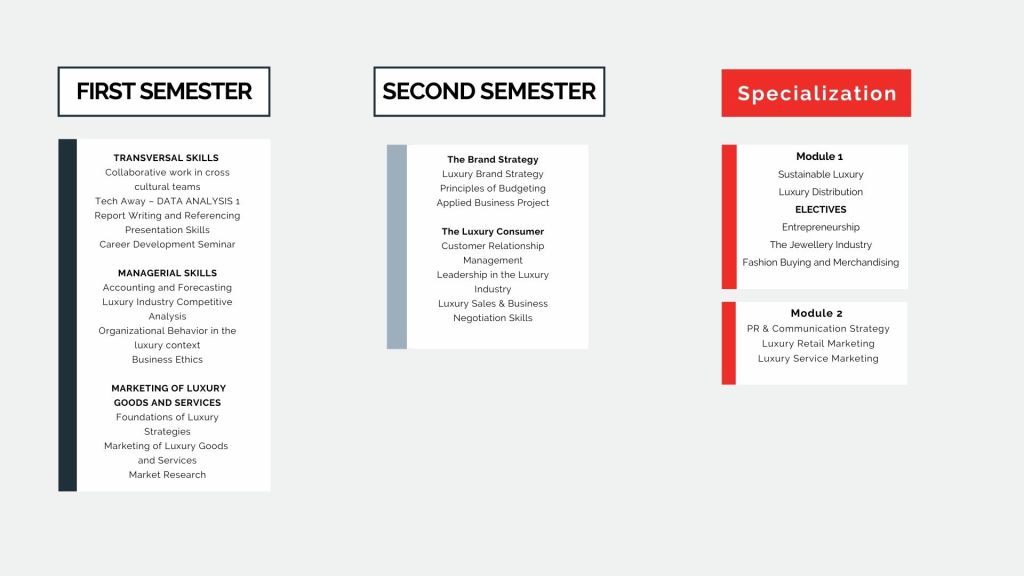
Some of the Courses offered
in the Master of Science in Luxury Hospitality and Event Management
Introduction to Luxury Goods and Services
This course provides a broad overview of the entire luxury industry and outlines the diversity of numerous luxury sectors: the history, the evolution of luxury, markets, major players, and trends,...
Using case studies, articles and other professional reports, the course considers methods and techniques for organizing and managing the unique factors impacting the industry.
Luxury Industry and competitive analysis
We provide students with the opportunity to critically review microeconomic and macroeconomic theories, conceptual frameworks and other models in order to understand the dynamics of a given industry and to conduct in-depth analysis within the Luxury Goods industry. All this culminates in the preparation of an Industry Analysis Report in which the students should demonstrate the knowledge acquired throughout this course.
Accounting and Financial Management in the Luxury Industry
This course provides a general overview of how accounting and financial management contributes to the luxury organization. The course provides an overview of the financial aspects involved in making luxury business decisions such as forecasting, budgeting, optimizing, valuing, evaluating, and auditing results.
Marketing of Luxury Goods & Services
This course provides an overview of the entire luxury marketing management process in a global context. It explores the role marketing plays within luxury companies and focuses on the development and analysis of consistent marketing strategies.
It describes how consumers are the focus of all marketing actions and how environmental changes influence marketing strategy development and implementation.
Luxury Communications and Media Planning
This course introduces students to the ways in which marketing communications are used within the global brand marketing strategy, with a specific focus on the luxury industry. It examines ways in which communication strategies establish a dialogue between providers of a luxury product and their respective publics or markets.
Human Factors in the Luxury Industry
This course focuses on organizational behaviour and systems, and human resource management for the luxury industry. It concentrates on the variables that affect behaviour at the individual level and then goes on to a thorough examination of the foundations of group dynamics.
Luxury Service Audit & Performance Indicators
This course will develop a framework for understanding the essential elements needed to audit “the service” that is provided in luxury brand boutiques and hotels.
It emphasizes learning more about customers' needs and behaviors within a hospitality setting in order to develop stronger and more efficient relationships with them.
The final session examines how to effectively present and communicate the audits to a luxury company, which will then be presented publicly, in a professional, quantitative and qualitative manner.
Luxury Consumer Behaviour
This course investigates the dynamics of human behaviour and how it relates to decision making in the luxury sector. It concentrates on the most important factors that influence the consumer’s decision making process. These include, at the individual level, motivations, personality traits and the self-concept, values and lifestyles, as well as psychological processes and at the social and cultural level, group membership, social classes and subcultures. The course also discusses definitions of culture and how these affect postmodern consumer mores, how members of different cultures vary, and on what criteria they can and cannot be compared.
Luxury Services
This course will examine the unique aspects of services management and marketing, with a particular focus on services in the luxury environment. The methodology used will be both theoretical and practical.
Underlying the approach of this course is the “service perspective”. According to this perspective, customers are not looking for goods or services, but rather for benefits or solutions to their problems. In other words, to be competitive, firms need to understand their selected customers’ total needs in order to design and deliver the core solution: the pertinent package of goods and services.
CRM & Client Database Management
The course approaches its subject matter from a relational viewpoint. That is, it emphasizes learning more about customers ‘needs and behaviours in order to develop stronger relationships with them, through technology and by integrating information about consumers, sales, marketing, responsiveness, and luxury market trends. Topics include CRM and the sales force, and the use of CRM software to manage a sales force; lead and contact management tracking; forecasting sales leads and the importance of conversion rates; customer interaction and the Web; and call centers and help desk management. Students will learn how to use CRM technology to gain insight into customers and understand the critical value customers possess. On completing the course, they will understand the importance of using CRM software to create, track, and manage partnerships, contracts, and agreements; and in distribution management.
Hospitality Operations Management
This course examines the role of food & beverage, front of the house and service-related operations in the hospitality & leisure industries. Current technologies, tools, systems and procedures that are at the forefront of hospitality and tourism operations management are presented. Subject material will place emphasis on the ability to provide a practical understanding and exposure in the design, development, implementation, improvement and management for an actual hospitality enterprise.
Tourism Marketing & Sales
This course introduces the hospitality management student to the basic need and value of marketing and sales efforts among hotels, airlines, restaurants, travel agents, and others in the industry. Discussion and study topics include marketing research and analysis, development and implementation of traditional and online marketing plans and strategies, advertising, promotions, public relations, and pricing structures.
Sustainable Tourism
The rapid growth of tourism worldwide has created many challenges and opportunities for established and emerging tourism destinations. This course looks at how to conduct a tourism assessment to examine tourism potential, and how to measure the potential costs and benefits of a tourism development program. The course also reviews how and why tourists make destination choices, and learn how to develop a strategic marketing system that emphasizes a product or destination's distinctive appeal.
Event Management
This course will expose students to real world event management situations and gain the knowledge needed to understand the five stages of event management (research, design, planning, coordination, and evaluation), understand how to manage time and human resources effectively, have insight into hiring vendors, caterers, sound and light technicians, entertainment, and other resources, learn how to conduct an event site inspection, be knowledgeable about risk-management procedures and tactics, learn about the requirements for necessary contracts, permits, and licenses, and how to meet these requirements and understand budgeting, pricing, and accounting as they relate to event design.
Team Management
This course introduces the various tools and techniques related to team management, with a special focus on the hospitality environment. The material will cover topics such as the Management role, Leadership Skills, Key skills of successful managers, Assessing and adapting management styles, Team dynamics, Characteristics of an effective team, Understanding team roles and identifying them within a team, Managing team performance, coaching/counselling techniques and developing the team's strengths. There will be a high degree of discussions so that the collective knowledge of the student group can be shared and built upon.
Organizational Management
During this course Students will examine the management of the complex relationships within an organization and discuss concepts of organizational theory. The focus of the course material is to provide an opportunity to learn about the available theory and state of the art management practices. During this course, students use management-appropriate research methods and tools to address a management challenge of their own choosing. By the end of this course, students will be familiar with the process of planning, organizing, leading and controlling the efforts of organization members and resources to achieve stated organizational goals.
Hospitality Strategic forecasting & Budgeting
This course covers core forecasting and budgeting concepts such as costing methods, budget process, capital budgeting, revenue forecasting, cost accounting, budget analysis and the balanced scorecard. The course shows also how specific tools are applied in budgeting and forecasting techniques, such as pivot tables and management of financial databases. Students will make use of case methodology and exercises to create, execute and analyze different types of budgets; perform Cost-Volume-Profit and Break-even analysis, especially applied to the hospitality industry. The material also reviews optimization of financial decision-making through Strategic Planning and the Budgeting Process, Capital Investment Appraisal, Financing and Cost of Capital, Costing Techniques, Corporate Budget Process, Forecasting Methods, and Budget Controls.
Hospitality Quality Systems, Processes & Performance Indicators
This course introduces the varied tools and techniques used in the hospitality industry to develop, implement, improve and monitor Quality Systems and Processes. A special focus will be on topics such as the definition of quality of service, a review of the causes of service quality and what organizations can do to improve quality of service. Students will be made aware of the importance of quality management and its main objective to achieve in efficient and effective conditions only products that meet all customer requirements while complying with the society requirements, with applied standards and specifications, to take into consideration all aspects regarding consumer and environment protection.
A Professional Immersion (6-month Internship) is also included in the curriculum.
Please note that this list is not exhaustive and subject to change
...To Practice
Exchange your thoughts to inspire new ideas
The MSc in Luxury Hospitality and Event Management program ensure that curriculum matches the luxury business standards by working with luxury industry players.
The interaction with these companies goes through several possible activities:
- Professional guest lecturers and series of
CEO conferences (Chloé, Bulgari Hotel, Façonnable, JWT, Parmigiani, Mauboussin, Gucci, Fraser Yachts, Wally, YSL, Sergio Rossi,…)
- Attending the
most important events and fairs linked with the Luxury world (Car show in Geneva, Monaco Yacht Show and Luxe Pack in Monaco, TFWA in Cannes, Fiera del Mobile in Milan, International Jewelry Show in Valenza, Luxury Briefing conference in London…)
-
Field trips are organized yearly to further reinforce understanding of professional expectations. Students visit major firms or industrial plants in European capitals having the chance to go straight to the main source of the information.
Some of the companies visited and guest lecturers: Hotel de Crillion Paris, Bulgari Hotel, Lungarno Collection Hotels, Le Métropole Monaco, Château Eza, Hotel de Paris, Orient Express Hotels, Les Thermes Marins de Monte-Carlo, Silver Sea Luxury Cruise Line, Casino of Monte-Carlo,…
-
Employer Branding presentations inviting HR managers interested in communicating on the company’s values and business results and in recruiting our students.
Career Opportunities for the Master of Science in Luxury Hospitality and Event Management students
The MSc in Luxury Hospitality and Events Management provides the opportunities for graduates to pursue careers in the travel and tourism industry, events management, tourism policy and Hotel & Tourism Property Management. The cursus has been designed to offer a broad yet focused multidisciplinary dimension. Students will have gained a solid understanding of the Luxury Hospitality Industry based on operational and strategic cutting edge material and educational processes.
Students may consider the following careers:
General Manager/Hotel Director: Overseas the entire hotel operations, which includes food and beverage, rooms division, front of the house, as well as support departments such as sales, finances, engineering, safety and human resources. Overall accountable towards the owners and operators for the safe and efficient running of the property.
Food & Beverage Manager: Overall responsibility and accountability for the food outlets (restaurants, bars, convention) as well as kitchen and provisioning; position is usually available in hotels, resorts, cruise ships, airlines, convention centers, casinos.
Hotel Departmental Manager: responsible for the efficient running of one hotel/cruise ship specific department, such as guest services, reception, housekeeping, restaurants, kitchen, engineering, convention.
Sales & Marketing Director: Accountable for the commercialization of the property, which usually includes both marketing and sales responsibilities.
Event Manager: Project Manager responsible for creation, planning, and development of events and conferences; responsible also for post-event analysis and ensuring a return on investment.
Revenue Director: Accountable for the yield management process for the property, which includes reservations, rates, and revenue generation and occupancy/Revpar targets.
Financial Director/Officer: Responsible for maintaining financial, accounting, administrative and personnel services in order to meet legislative requirements and support the property’s operations.
Human Resources & Training Manager: Ensure that existing Human Resources standards and Company HR philosophy are integrated at every operational level and are consistent. Manages and coordinates the development and implementation of HR and training processes to improve the overall quality of the product.
Project Manager/Construction Manager: Plan, coordinate and oversee the execution of one or more construction projects, to complete this work in the safest manner possible, at the lowest reasonable cost and in compliance with the owner's documents and quality requirements.
Brand Manager: Brand managers are concerned with creating a lasting impression among consumers and improving product sales and market share. A brand manager monitors market trends and oversees advertising and marketing activities to ensure the right message is delivered for their product or service. They work closely with many teams, including product developers, researchers, marketing personnel and creative agencies to make sure their company brand values and image are followed.
Spa Manager: responsible for the safe and efficient running of all spa operations for the property, which usually includes beauty salon, spa services as well as fitness center.
Casino Manager: responsible for the safe and efficient running of the casino operations for the property.